Andrew Rees
Dr D A S Rees
Department: Mechanical Engineering
Job Title: Reader in Fluid Dynamics
Visiting Professor at the Université Paul Sabatier, Toulouse, France
Qualifications: PhD (Applied Mathematics, Bristol, 1986)
BSc (1st in Mathematics, Imperial College, 1980)
ARCS (Royal College of Science/I.C., 1980)
ATCL (Trinity College of Music, London, 1977).
E-mail Address: D.A.S.Rees@bath.ac.uk
or ensdasr@bath.ac.uk
Work Address:
- Department of Mechanical Engineering
- University of Bath
- Claverton Down
- Bath BA2 7AY
- United Kingdom
Extracurricular activities
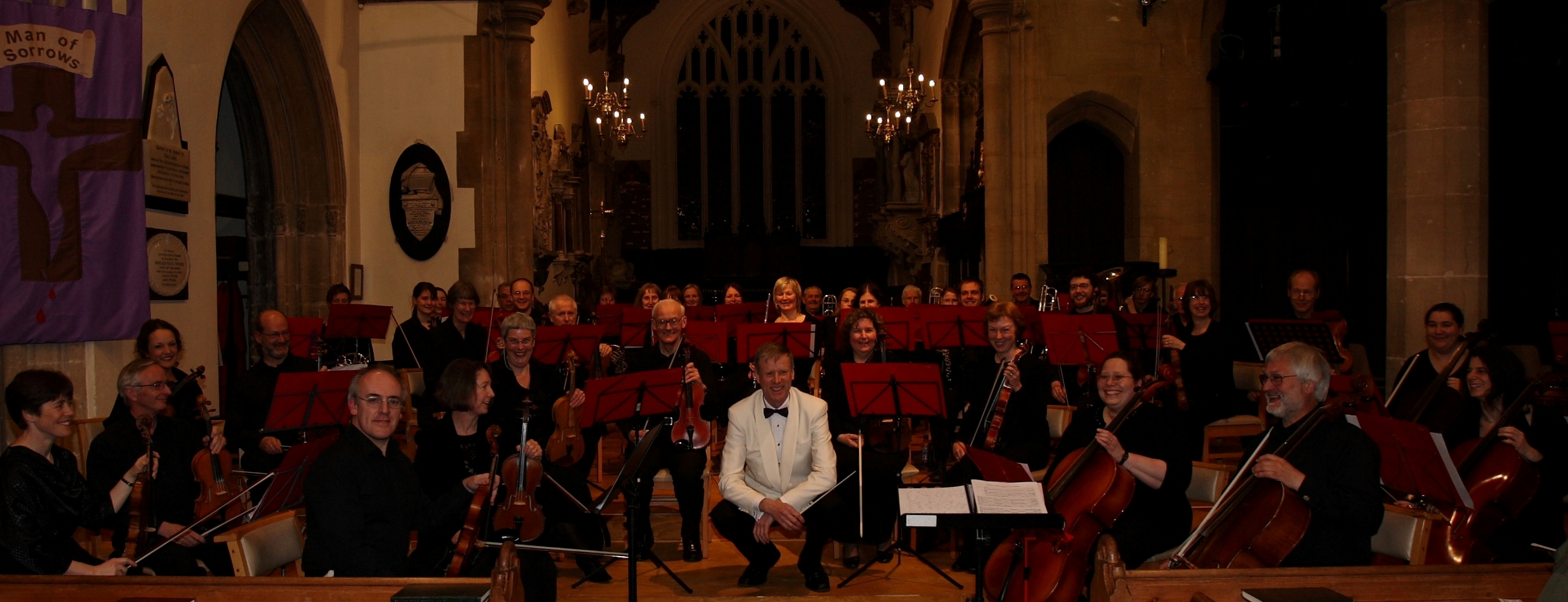
St. John the Baptist Church, Keynsham
Bristol Concert Orchestra
.
Keynsham Orchestra
.
Bristol Opera
Bristol/Bath cyclepath
homepage
Siân Rees: Supporting Head-Injured Pupils in School. The
SHIPS project.
Undergraduate matters.... (University of Bath username and password required)
Engineering Mathematics 1 (ME12002)
Modelling Techniques 2 (ME20021)
Old units no longer running:
Mathematics 1 (ME10304) (up to 22/23)
Mathematics 2 (ME10305) (up to 22/23)
Academic background
After A-levels in Chemistry, Physics, Pure Maths,
Applied Maths and Music,
Dr. D. A. S. Rees obtained a first class honours degree in Mathematics
from
Imperial College
in 1980 and then worked for two years at British
Aerospace, Filton, on problems in structural dynamics and aeroelasticity.
He subsequently studied for a Ph.D. in Applied Mathematics
at
University of Bristol
under the supervision of Professor David Riley who is now at
University of Nottingham.
The thesis was entitled "Convection in porous media" and the degree awarded
in
1986. Following a three year postdoctoral research assistantship under the
same supervisor he was employed as a temporary lecturer in Applied Mathematics
at the
University of Exeter
for two years. He then joined the
Department of Mechanical Engineering
at Bath in
April 1990, and was promoted to a Readership in September 1998.
He currently has 197 journal papers and seven review chapters in print.
There are two more which are submitted and one that is just about to be submitted.
His current publication list is
here,
(note: the list may be seen but access has been restricted to UoB for copyright reasons)
and submitted papers and those to appear are
here.
His ResearchGate profile may be found
here.
In 2006 he was presented with the Mary Tasker Award
for Teaching Excellence by the University of Bath, with a further nomination in 2013.
In 2007 he presented the
G I Taylor Memorial Lecture at the 52nd ISTAM conference in
Bangalore, India.
In 2009 he became a
visiting professor at the Université Paul Sabatier, Toulouse, France.
In 2012 he was the co-chair for the 5th International Symposium on Advances
in Computational Heat Transfer which was held at the University of Bath from 1st to 6th July.
In 2015 he was named as Outstanding Reviewer for the
International Journal of Numerical Methods for Heat and Fluid Flow.
In 2016 he was named as Outstanding Reviewer for the A.S.M.E. Journal of Heat Transfer.
In 2017 he was named as Outstanding Reviewer for the
International Journal of Numerical Methods for Heat and Fluid Flow.
He also has an A.T.C.L. diploma in
violin performance from the
Trinity College of Music, London
which he obtained in 1977, and is a former member of the
Cerddorfa Genedlaethol Ieuenctid Cymru.
He is or has been on the editorial board for the following journals:
Journal of Porous Media (1998-2011)
International Journal for Numerical Methods in Heat and Fluid Flow (from 2004)
Computational Thermal Sciences (from 2008)
Special Topics & Reviews in Porous Media - An International
Journal (2010-2011)
Transport in Porous Media (from 2013).
Fluids (MDPI) (from 2016) and Editor-in-Chief from March 2023.
He is an unashamed
Fortran
programmer.
Research Interests
(Updated 8/2016)
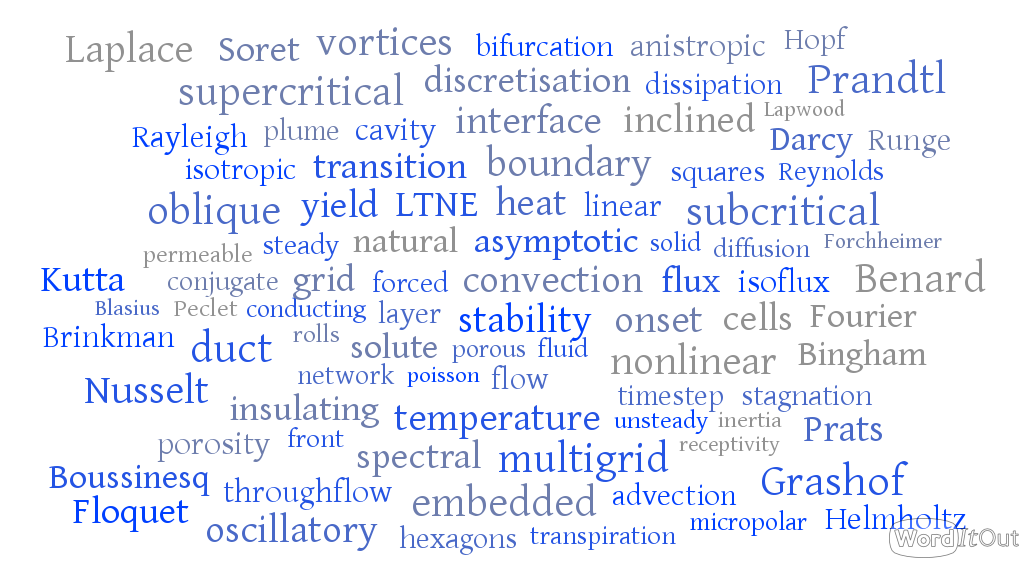
 I am interested in many areas of fluid dynamics especially convective flows,
such as free convection boundary layers, convection in layers and buoyancy
induced flows in porous media.
Liquores moventur in multicavum solida calefacta.
In particular, my aim is to investigate the
stability of these flows, to determine how, where or when they become unstable,
and to follow the subsequent evolution of such instabilities.
To this end I use a combination of analytical methods such as parallel and
nonparallel stability theory, weakly nonlinear theory, and numerical
methods such as direct solvers, multigrid methods and direct numerical
simulation.
All numerical work undertaken courtesy of
Fortran!
I am interested in many areas of fluid dynamics especially convective flows,
such as free convection boundary layers, convection in layers and buoyancy
induced flows in porous media.
Liquores moventur in multicavum solida calefacta.
In particular, my aim is to investigate the
stability of these flows, to determine how, where or when they become unstable,
and to follow the subsequent evolution of such instabilities.
To this end I use a combination of analytical methods such as parallel and
nonparallel stability theory, weakly nonlinear theory, and numerical
methods such as direct solvers, multigrid methods and direct numerical
simulation.
All numerical work undertaken courtesy of
Fortran!
To date I have 193 journal publications, 64 conference papers and seven review chapters.
I also have two sets of typeset lecture notes
for overseas courses entitled:
Perturbation Methods for solving ODEs and PDEs
(University of Dhaka, September 2000) and
The Stability of Darcy-Bénard Convection
(Summer School on Porous Media,
Neptun, Constanţa, Romania, July 2001).
The course on Darcy-Bénard convection summarises aspects of
the linear and weakly nonlinear stability analyses which may be
undertaken for this problem both in its classical form
and for some of its various modifications. Should anyone download either of
of these courses, then please let me know by email so that I can
gauge the level of interest in these topics.
At present I am collaborating with a number of researchers from different
countries.
Prof Andrew Bassom
(UWA Perth, Australia) and I are investigating thermal boundary layer instabilities of
various types.
Much of my work is focussed in instabilities in layers, and my collaborators are
Prof Antonio Barletta (Bologna, Italy),
Prof Kader Mojtabi (UPS, Toulouse, France),
Prof Pradeep Siddheshwar (Bangalore University, Bangalore, India),
Dr Aminreza Noghrehabadi
(Shahid Chamran University of Ahvaz, Ahvaz, Iran),
Dr P M Patil (Dharwad, India),
and
Dr Syakila Ahmad
(Universiti Sains Malaysia, Penang, Malaysia).
Vortices
In addition to the above,
I have developed codes to simulate
vortex instabilities in free convective boundary layer flows in porous media.
When the heated surface is close to the vertical, the distance
from the leading edge beyond which vortex disturbances grow is very large.
Thus it is possible to apply the boundary layer approximation to the
disturbance equations to obtain a mathematically consistent description of
the fate of disturbances. Moreover, nonlinear vortex development and secondary
instabilities may also be described within this framework.
Waves
My recently graduated PhD student, Manosh Paul
(now at the University of Glasgow), undertook a numerical study of
the
linear and nonlinear development of two-dimensional waves
in the classical vertical free convection boundary layer flow of Newtonian fluid
from a constant temperature surface. The code solves the fully elliptic system
and the work concentrates on (1) how an isolated thermal disturbance evolves in
time and develops spatially and (2) how the boundary layer
responds to an oscillatory
disturbance. For (1) we find that the flow exhibits the (confusingly so-called)
convective instability which we attribute to the fact that the basic flow accelerates.
In (2) we find that the boundary layer has a resonant frequency in the sense that there is
one specific frequency of disturbance which maximises the linear response.
More recent work has extended the analysis to nonlinear convective waves.
 LTNE
LTNE
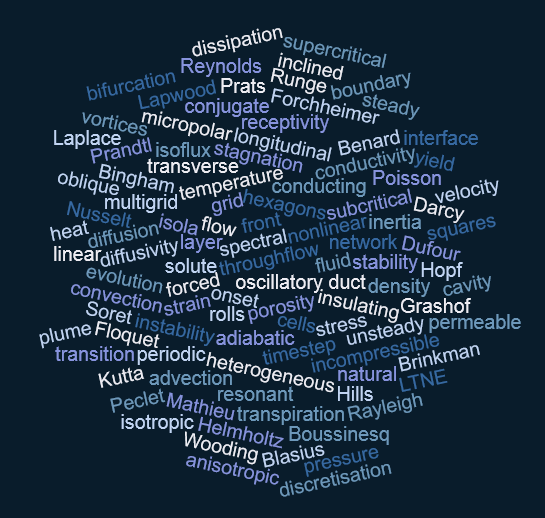
Another research focus has been the
microscopic modelling of local thermal non-equilibrium
effects in porous medium convection.
Many situations exist where the usage of a single
thermal energy equation fails to describe adequately the development of the thermal
field in a porous medium. Such situations often involve relatively fast fluid motion
so that hot fluid, for instance, may penetrate a great distance into a porous medium
before the solid phase is able to heat up substantially. In such instances two energy
equations may be used to model the evolution of the temperature fields in the two phases.
These equations are coupled by a simple linear source/sink term to allow heat to transfer
between the phases. A heat transfer coefficient has been postulated, but little is known about
how it depends on the physical structure of the porous medium and the thermal properties of
the fluid and solid phases.
Bingham fluids
My most recent work has been on the modelling of the flow of
Bingham fluids in porous media.
These are yield-stress fluids which effectively remain solid unless the applied shear stress
is sufficiently large. When saturating porous media, the equivalent is that the fluid is
stagnant until imposed body forces (e.g. pressure gradient, buoyancy forces) exceed
a threshold value. Numerical simulations of the those flows, both isothermal and convective,
are hampered by the need to determine where the yield surface is. Progress may be made
by the use of a regularization of the governing equations which softens the
discontinuity in the governing equations at the threshold.
It is also possible to undertaken simple upscaling analyses for porous media with a regular
pattern of channels. In such cases the presence of a microscopic yield stress means that
flow in such networks will be anisotropic even though the network is isotropic for
Newtonian fluids.
So far he has published eight journal papers, one review chapter and two conference papers.
Diffusion coefficients
I have worked with
Prof Mounir Bou-Ali and Miren Larrañaga (Mondragon University, Spain)
on the mathematical modelling of the Sliding Symmetric Tubes method
of determining direct and cross-diffusion coefficients in binary and
ternary fluids, with extension to higher order mixtures.
Recent Collaborators:
✟
Adrian
Postelnicu,
Thermal Engineering and Fluid Mechanics, Universitatea Transilvania din Braşov, Romania.
Aminreza Noghrehabadi, Department of Mechanical Engineering, Chamran University of Ahvaz, Ahvaz, Iran.
Andrew Bassom, Department of Mathematics and Statistics, University of Western Australia, Crawley,
Perth, Australia.
Andrey Kuznetsov, Department of Mechanical Engineering, North Carolina State University,
Raleigh, NC 27695-7910, USA.
Antonio Barletta, Dipartimento di Ingegneria Energetica,
Nucleare e del Controllo Ambientale, Alma Mater Studiorum
- Universita di Bologna, Bologna, Italy.
✟
Anwar Hossain, Department of Mathematics, University of Dhaka, Bangladesh, and COMSATS University, Islamabad, Pakistan.
Arunn Narasimhan, Department of Mechanical Engineerning, IIT Madras, Chennai, India.
Carina Bringedal,
Inga Berre,
Jan Martin Nordbotten,
Department of Mathematics, Universitetet i Bergen, Norway.
✟
Darryl Almond, Department of Mechanical Engineering, University of Bath, Bath, UK.
✟
Don Nield,
Department of Engineering Science, University of Auckland, New Zealand.
Gamze Genç,
Department of Mechanical Engineering,
Erciyes University, Kayseri, Turkey.
Ioan Pop, Faculty of Mathematics, University Babeș Bolyai, Cluj-Napoca, Romania.
İsmail Solmuş, Department of Mechanical Engineering, Atatürk Üniversitesi, Erzurum, Turiey.
Leiv Storesletten,
Department of Mathematics, Universitetet i Agder, Kristiansand, Norway.
Manosh Paul, Department of Mechanical Engineering, Glasgow University, Scotland.
Michele Celli, Dipartimento di Ingegneria Energetica,
Nucleare e del Controllo Ambientale, Alma Mater Studiorum
- Universita di Bologna, Bologna, Italy.
Mikhail Sheremet, Department of Theoretical Mechanics, Tomsk State University, 634050, Tomsk, Russia.
Miren Larrañaga,
Departamento de Mecánica y Producción Industrial, Mondragon University, Spain.
Mohsen Nazari, Mechanical Engineering, Shahrood University of Technology, Iran.
Mounir Bou-Ali, Departamento de Mecánica y Producción Industrial, Mondragon University, Spain.
Peder Tyvand,
Department of Mathematics, Universitetet for miljø- og biovitenskap (Norwegian University of Life Sciences), Ås, Norway.
Pradeep Siddheshwar, Department of Mathematics, Bangalore University, Bangalore, India.
P M Patil, Department of Mathematics, Dharwad, India.
Syakila Ahmad,
School of Mathematical Sciences, Universiti Sains Malaysia, Penang, Malaysia.
Last updated 14th October 2017.