My publications list on google scholar
Current Research Topics
Solar Commission Report I chaired the Solar Commission whose aim is to show how the UK's extensive innovation and industrial capabilities can be harnessed to enable the UK to play a leadership role in what will undoubtedly be one of the key energy generation technologies of the coming decades. This report was launched at the House of Lords Tues 9 July 2019.University of Bath Research with Impact Podcast with Roland Pease: 'A bright future for solar energy' features interviews by the internationally renowned journalist Roland Pease with Prof Petra Cameron and myself on the future of solar power.
Applying machine learning to perovskite solar cell modelling describes recent advances by my research group on utilising artificial intelligence to understand the new solar technology of perovskite solar cells.
Links to the two recent papers mentioned in this announcement are as follows
Bayesian parameter estimation for characterising mobile ion vacancies in perovskite solar cells
S. G. McCallum, O. Nicholls, K. O. Jensen, M. V. Cowley, J. E. Lerpinière, A. B. Walker J Physics: Energy 6 015005 (2024) DOI:10.1088/2515-7655/ad0a38
Bayesian optimisation approach to quantify the effect of input parameter uncertainty on predictions of numerical physics simulations
S. G. McCallum, J. E. Lerpinière, K. O. Jensen, A. B. Walker APL Machine Learning 1 046106 (2023) DOI: 10.1063/5.0151747
Talk on my group's work on Multi scale modelling of organic devices and perovskite solar cells
This talk was part of the Workshop “Polarons in the 21st Century” held December 9 –13, 2019 at the Erwin Schrödinger International Institute for Mathematics and Physics
Solar Cells
Solar cells are devices that produce electricity from the sun's energy through the creation and subsequent dissociation of an exciton. The way in which they work is similar to natural photosynthesis.WHAT TYPES ARE THERE?
There are several solar cell technologies and in each, the light-active component and other cell materials are different.
Organic solar cells consist of layers and/or blends of organic materials.
Hybrid solar cell These solar cells consist of a mixture of organic and inorganic materials.
Perovskite solar cells
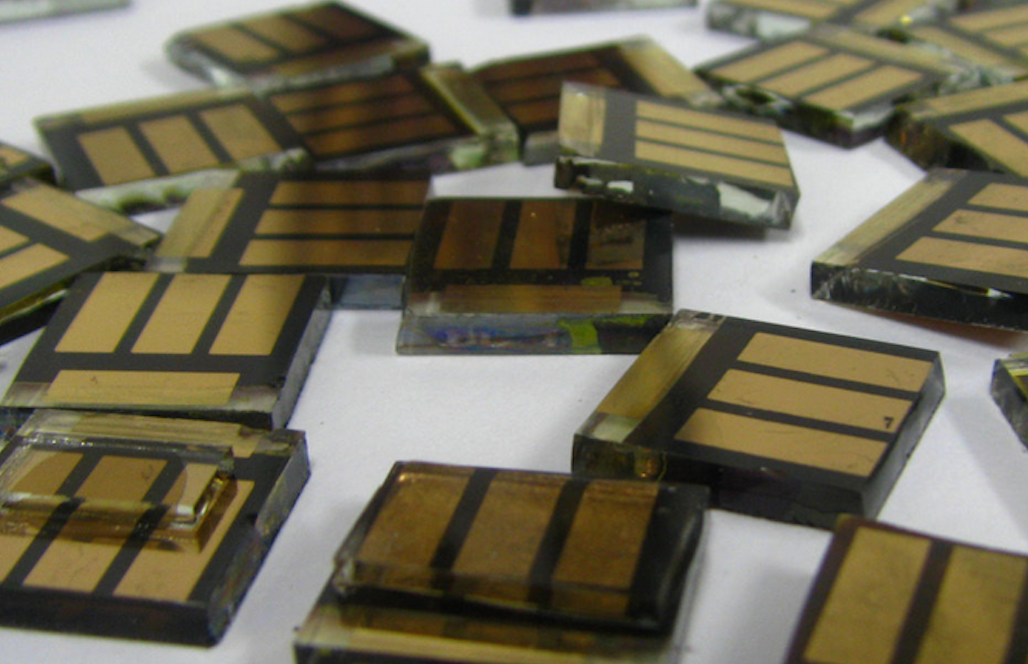 Image courtesy of University of Oxford.
Useful links
Perovskite-Info Perovskite Solar & Light Emitting Diodes
The Solar Spark solar power education website
Organic Materials and Devices
Organic Materials and Devices We're all taught at school that plastic is an insulator, but some carbon-based small molecules and polymers do conduct electricity. Unlike silicon-based electronics, organic electronics are relatively low performance but cheap and flexible. And when they conduct, they can light up, click here for my article on lighting based on organic light emitting diodes (OLEDs), be used in displays, or convert light to current in photovoltaics.WHAT DEVICES ARE THERE?
Organic Field Effect Transistors used in smart packaging, brand protection, security, smartcards, distribution tagging and Radio Frequency Identification Devices, interactive media, disposable electronics, and (flexible) display backplanes. Organic devices are being developed that can restore or replace functions of the human body through managing the interface between electronic devices and cells, tissues and organs.
Summer Schools and Symposia organised
DeModeP23 - Characterisation and modeling of devices with Enrique Hernández Balaguera. Part of MATSUS23, Materials for Sustainable Development Conference, Valencia 6-10 March 2023.ISOPHOS International School on Hybrid and Organic Photovoltaics 2019 with Aldo Di Carlo, Lucio Cina (University of Tor Vergata, Rome) 2-6 Sept Castiglione della Pescaia, Tuscany, Italy dedicated to PhDs, Post Docs and Researchers. This school was a training event TE5 for the ITN Maestro (see right hand column).
EXTMOS Summer School From Molecules To Organic Electronics Materials with Claudio Zannoni, Paulo Pasolini (University of Bologna) Erice 1-7 Oct 2018
Modelling Perovskite Solar Cells Microscale to Macroscale with Claudio Quarti (University of Mons). Part of the nanoGe Fall Meeting 2018 22-26 Oct 2018 Forum for the rapidly expanding and multidisciplinary community of scientists engaged in modelling perovskite solar cells.