Chris Budd


Professor C J Budd

-

Chris and Benji, I am the one with the glasses
Department: Mathematical Sciences
Job Title: Professor of Applied Mathematics at the University of Bath and Professor of Mathematics at the Royal Institution of Great Britain

Telephone: +44 1225 386241
Fax: +44 1225 386492

E-mail Address: cjb@maths.bath.ac.uk

Postal Address:

Here is my Curriculum Vitae


Research Interests:

I am interested in the theory, application and computation of nonlinear problems (linear problems are for cissies) with special interest in problems which arise in industry. Much of my recent work has been on the development of accurate adaptive methods for solving nonlinear parabolic equations based upon the application of ideas from the theory of Lie groups, which inherit the dynamics and associated conservation laws of the underlying partial differential equations. I also have a very strong interest in interdisciplinary projects closely linked to applications ranging from geology to micro-wave cooking and from digestion to folk dancing.

Education and Public Engagement Interests:

I have a strong interest in promoting mathematics to the general public, especially to young people. I am a member of the CMS Maths Promotion Unit , Professor of Mathematics at the Royal Institution, lecturer for Maths Inspiration , coordinator of the Bath Taps Into Science Festival and of the Wessex Maths Masterclasses. In 2001 I was awarded a National Teaching Fellowship NTFS and have used this to create a degree credit programme on 'Maths Communication'.If you are interested in getting involved in public engagement work and would like to find out more, then have a look at my talk I also have a strong interest in mathematics education and serve on a number of bodies that support mathematical education. These include the MSOR Subject Centre, the MEI Industry Ctee and the More Maths Grads executive committee. I am also the Education Secretary of the London Mathematical Society . Some details of the work of the LMS Education Committee (which I chair) are given in the following LMS Newsletter article
My philosophy for teaching is simple. Be aware of (and enjoy) your audience and be hugely enthusiastic about your subject. Some of my talks/articles on maths education: As a candiate for the role of Education Secretary in the forthcoming LMS election I am pleased to have the opportunity to describe some of my work and beliefs as the current LMS Education Secretary, since taking over from Brian Stewart in 2006, and to give some idea of my visions for the future role of the LMS in education in these very challenging and fast moving times. (Note that a description of some of the work of the Education Committee is given in my article for the July LMS Newsletter). I am passionately committed to promoting both mathematics education and also the broader appreciation and popularisation of mathematics at all levels, from school to HE and beyond. In recent years the Education Ctee has addressed all of these areas. As an active research mathematician, I also believe strongly that good mathematics research and good mathematics teaching are mutually supporting and intimately connected, and that both are vital for the health of UK mathematics. This certainly means that we must have a strong and vibrant dialogue between schools and HE and I have done my best to promote this, with a much broader focus on education than just HE matters. Indeed in recent years the Education Ctee has addressed such issues as the changes to GCSE, Diplomas, post 16 and A-level teaching, enrichment and engagement activities with schools, benchmarking of undergraduate degrees, training of maths lecturers, the issues related to the Bologna agreement and the popularisation of mathematics. I terms of what I believe and hope to achieve. Firstly, I believe that we should have a schools and HE programme of teaching maths which really engages, stimulates and challenges our students so that we can produce the next generation of both mathematicians and also mathematically rich disciplines. This certainly means that we must have challenging mathematics A levels (Maths and Further Maths) which engage a good number of students and adequately prepares them for the rigours of doing a mathematically demanding degree. I also believe that GCSE should stretch and challenge the best students whilst still engaging all students. The latter has been the motivation behind the recent support of the LMS Education Ctee for the twin GCSE. I will continue to champion high and improving standards at all school levels. I am also very concerned that far too many students drop maths post 16. This means that almost uniquely in the industrialised nations we do not teach maths to all students up to the age of 18. I do not believe that this is healthy for the future of the nation and I support the Pathways approach, outlined in the 2004 Smith Report (to which the LMS Education Ctee contributed) in which different mathematical courses are designed to meet different needs of the students. I hope that we can seek a world in which all school leavers are mathematically literate and I will endeavour to make this possible. I recognise that in a world of limited resource (both in money and in trained teachers) that there are tensions (and potential dangers) between supporting a demanding A level for the good mathematicians and also ensuring that more students study maths post 16. To address these tensions I strongly support (both morally and on the ground) initiatives to both encourage and guide the students and teachers on these courses so that we can maximum use of available resource and can lobby for more resource. For example I am a strong supporter of the Further Maths Network and also the development of on-line and electronic resources for schools. I also believe that the LMS members should be engaged in writing excellent text books for this age group;. The Education Committee has been actively involved in a number of initiatives to directly link HE Mathematicians with schools (such as More Maths Grads, Maths Careers, HE-STEM) and I firmly believe that the LMS and its members should play and active role in developing more such initiatives in the future. The Education Ctee is also heavily involved in a close dialogue on maths teaching with QCA, ACME, JMC, HODOMS and various learned societies, and I firmly believe that this should continue. I also support vigorous efforts to support, recruit, retain, train, develop and enthuse excellent maths teachers. We can only have good maths teaching if we have good maths teachers. The LMS Education Ctee has worked closely with the NCETM and strongly supports initiatives to develop CPD for maths teachers linked with HE. I also believe strongly that we should encourage as many good students as possible to go into maths teaching and support initiatives such as the UAS which gives such students the opportunity to act as ambassadors between HE and schools. The Education Ctee has always taken the role of supporting the teaching of maths at HE extremely seriously, recognising that there are many aspects of teaching maths at HE which make it quite different from other subjects. The Ctee played a major role in formulating the benchmark statement for HE maths teaching, and recently is in the process of formulating a Teaching Statement to give support for any LMS member in HE that has to make the case of teaching maths in a special way, to higher management. I am also very concerned that the current 'training' of new maths lecturers is far from being fit for purpose, and the Education Ctee has lobbied hard (and will continue to lobby) for proper, subject specific, training of new lecturers. Finally I firmly believe that to convince the powers that be to fund maths we must continue to make the case for the beauty, power, relevance and importance of ALL branches of mathematics to everyones lives. To this end the Education Ctee supports a number of initiatives to popularise mathematics including the popular and Gresham lectures, the Holgate scheme with schools, the small educational grants and the British Science Festival. I passionately hope that the LMS and its members will continue to support, and get involved with, this work. As a research mathematician I feel a great responsibility for educational and public engagement activities to explain what our research is about, to motivate and enrich our teaching and to ensure continuing support for research. I am conscious that with the major changes that are happening both within the LMS and beyond, that it is important that all LMS members have the opportunity to make their views known in the education debate, and I plan, if elected, to host an LMS meeting in which various bodies actively engaged in maths education can meet with members, and that by doing this we can together forge a really effective policy for maths education in the future. CJB 14/10/09

Non-smooth dynamics

What happens to dynamical systems when we remove the constraint of smoothness? Lots of new and exciting dynamics occur!! A review of these is given in my new BOOK on Piecewise-smooth Dynamical Systems: Theory and Applications, joint with Mario di Bernardo, Alan Champneys and Piotr Kowalczyk published by Springer.

-


Geometric Integration and Adaptivity:

Geometric integration is a new branch of numerical analysis which aims to reproduce the qualitative features of the solution of the differential equation which is being discretised. An account of this new area is given in the following set of notes (100 sides) which formed the basis of a short course at SCICADE 01
  • Geometric integration and its applications. C.J.Budd and M.D.Piggott (2001)
  • A particular interest of mine is the relationship between geometric integration and adaptive methods for ODEs and PDEs. I gave a recent short course on the for the LMS/EPSRC Spring school in Cambridge (2002).

    Research talks:

    These are some research talks on geometric integration and grid generation
  • Introduction to the geometric integration of ODEs
  • Adaptivity, scaling and geometric integration methods for PDEs
  • Some geometric integration methods for PDEs
  • Parabolic Monge-Ampere methods for mesh generation
  • Adaptivity and symmetry for ODEs and PDEs
  • These are two talks on maths in the food industry
  • The mathematics of digestion
  • Microwave cooking: theory and experiment
  • These are two talks on non-smooth dynamics
  • Chattering and grazing in impact oscillators
  • Bouncing, sliding and switching: bifurcations in piecewise-smooth systems
  • These are three talks that give a review of piecewise-smooth dynamics and were a mini course delivered at the UK-Japan Winter School in January 2009.
  • Piecewise-smooth dynamics: I. Introduction
  • Piecewise-smooth dynamics: II. Maps
  • Piecewise-smooth dynamics: III. Hybrid systems and the grazing bifurcation.
  • And a talk on folding and geology
  • Level set methods for multilayer geological folding
  • And a talk on GPS, Complexity and the Ionosphere
  • Imaging of complex behaviour in the upper atmosphere

  • Bath Institute for Complex Systems, BICS:

    I am director of the Bath Institute for Complex System BICS which is an interdisciplinary institute exploring the many aspects of complex systems and their applications. It has an active research and workshop programme .. see the web-site.

    MSC in Modern Applications of mathematics:

    I am director of the Bath Msc course in Modern Applications of Mathematics which aims to give a training in modern interdisciplinary applied mathematics to anyone interested in applying mathematics in their career. For further information email or look at the home page for the MSc above.

    Appointments and Committees:

    I also have the following appointments and am on the following committees

    Other groups I am Involved With:


    Mathematics for the general public:

    I regard it as essential that mathematics is presented in an exciting and stimulating way for a general audience. As part of this I am Chair of Mathematics at the Royal Institution of Great Britain vice-chairman of the Bath/Bristol Royal Institution Masterclasses for 13-14 year olds and served on the EPSRC Public Understanding of Science Committee.

    Public talks, lectures and workshops:

    I love giving talks about maths and its applications to all ages, especially young people. DO CONTACT ME if you want me to come to give a talk. Here are a collection of some of my talks (which can be given either as stand alone lectures or as part of a workshop with extra activities).
  • How to amaze your friends (talk) How to amaze your friends (worksheets)
  • Why does Rudolph have a shiny nose?
  • Bath Taps Into Science
  • Eat, drink and be merry with maths
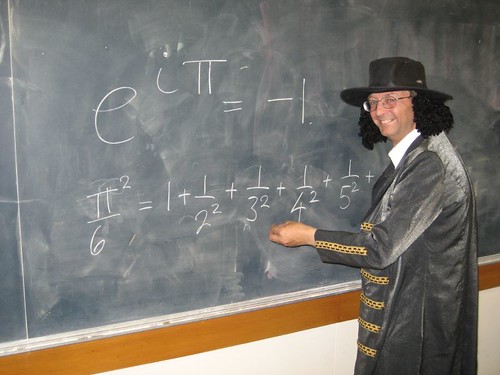
  • e, i, pi and all that
  • Making sense of a complex world
  • Maths, magic and mystery
  • How maths can help in the fight against crime (talk) Forensic maths (worksheets)
  • Dancing with maths
  • What's the use of chaos_
  • Maths of castles (talk) Maths of castles (workshets)
  • Celtic and African Knots
  • What have mathematicians done for us?
  • 101 Uses of a Quadratic Equation
  • How maths can save your life
  • How maths can change your life .. careers which use maths

  • Mathematics Galore:

    My book .Mathematics Galore co-authored with Chris Sangwin, published by OUP is a collection of these classes. See the review in Plus Maths. A new book called `101 uses of a quadratic equation', is underway .. watch this space.

    Bath Taps Into Science:

    Is an annual science road show, funded by EPSRC, which I help to organise at the University of Bath and in Green Park Station in Bath as part of National Science and Engineering Week. The 2002 event won a prize from the Institute of Physics for `outstanding contributions to the public understanding of physics'. The 2009 event won the British Science Association award for the best science festival during National Science and Engineering Week. You can see some images of the event and find out more on

    Lectures:

    I give many public lectures on mathematics and write articles for the Mathematics on-line magasines
    NRICH and PLUS I was awarded an EPSRC PPU award to produce videos on a series of themes in maths and physics. I am involved with the Motivate programme of video conferencing maths workshops, and can give talks on Mathematical Magic, Mazes and Navigation if requested. A full listing is given here

    Resources:

    In partnership with the LMS I have developed the following set of resources for schools and have also produced the following set of videos and DVDs for a variety of ages Visions of Maths and Science

    Posters and articles:

  • I helped to design Maths Connects poster for the London Underground about mathematical networks
  • Worksheet 6: Click here_.

    Here are some of my recent popular articles

  • Confessions of an industrial mathematician
    C. Budd, (2008)
  • Crime fighting maths I
    C. Budd, (2005)
  • 101 Uses of a quadratic equation I
    C. Budd and C. Sangwin, (2004)
  • 101 uses of a quadratic equation II
    C. Budd and C. Sangwin, (2004)
  • Finding order in chaos
    C. Budd, (2003)
  • How Maths Can Make You Rich and Famous I
    C. Budd, (2003)
  • How Maths Can Make You Rich and Famous II
    C. Budd, (2003)
  • Does Nature Really Care About Rational Numbers
    A Friday Evening Discourse at the Royal Institution, C J Budd (2001)
  • Where in the world am I?
    C. Budd (2000)
  • Analemmatic Sundials: How to build one and why they work
    C. Budd and C. Sangwin (2000)
  • Maths aMazes
    C J Budd and C J Sangwin (2000)
  • Visions of Maths and Science:

    This is a series of popular maths and science videos aimed at teachers (and students) from Key stage one through to sixth form. So far these include: Bath Taps Into Science , Mathematical Magic, The Liquid Nitrogen Show, Living in a Complex World, What's the use of chaos and The Maths and Science Christmas Show. To appear shrotly are Bubbles and `All the fun of the fair'. Click here for an order form and more details about the project and click here for some video clips from the NRICH web-site.

    Undergraduate Course Material:

    Worksheets, handouts and general information on courses can be found here
  • MA10208 Methods and Applications a
  • MA10002 Functions, differentiation and analytic geometry
  • Math0014 Numerical analysis
  • Math0060 Nonlinear systems and chaos
  • Math0101 Mathematics for electrical engineers 3
  • XX20164 Mathematical modelling and MATLAB

  • MSc Course Material:

  • MA50174 Advanced Numerical Methods

  • Publications:

    Here are some recent publications, preprints and notes
  • How to adaptively resolve evolutionary singularities in differential equations with symmetry
    C.J.Budd and J.F. Williams, (2009)
  • Adaptivity with moving grids
    C.J.Budd, W-Z Huang and R.D. Russell, (2009)
  • Spatial chaos, breathers and phonobreathers in a pinned mechanical lattice
    S. Green, C.J.Budd and G.W. Hunt, (2009)
  • Bifurcations in Nonsmooth Dynamical Systems
    M di Bernardo, C.J.Budd, A. R. Champneys, P. Kowalczyk, A. Nordmark, G. Tost and P. Piiroinen, (2008)
  • The robustness of the emergent scaling property of random RC network models of complex materials
    N.J. McCullen, D.P. Almond, C.J.Budd and G.W. Hunt, (2008)
  • The dynamics of regularised maps with gaps, with applications to impacting and related systems
    S.R. Pring and C.J.Budd, (2008)
  • Moving mesh generation using the Parabolic Monge-Ampere equation
    C.J.Budd and J.F. Williams, (2008)
  • Image-model coupling: a simple information theoretic perspective for image sequences
    N.D. Smith, C.N. Mitchell and C.J.Budd, (2008)
  • Image-model coupling: application to an ionospheric storm
    N.D. Smith, C.N. Mitchell and C.J.Budd, (2008)
  • A comparison of models and methods for the one dimensional microwave heating of foodstuffs
    C.J.Budd and A. Hill, (2007)
  • Experimental and analytic studies of the microwave heating of cuboid moist foodstuffs
    C.J.Budd and A. Hill, (2007)
  • Level set modelling for the parallel folding of layered structures: comparisons with experiment
    J. Boon, C.J.Budd and G.W. Hunt, (2007)
  • Smooth boundary based optimisation using a fixed grid
    C.S. Edwards, H.A. Kim and C. J. Budd (2007)
  • An evaluative study on ESO and SIMP for optimising a cantilever tie-beam
    C. S. Edwards, H. A. Kim and C. J. Budd (2006)
  • Level set methods for the displacement of layered materials
    J.A. Boon, C.J.Budd and G.W. Hunt (2006)
  • A mechanical realisation of a symplectic numerical method with large step size
    S. C. Green, C.J.Budd and G.W. Hunt (2006)
  • Corner bifurcations in non-smoothly forced impact oscillators
    C.J.Budd and P.T. Piiroinen (2006)
  • Bifurcations in Nonsmooth dynamical systems: Review article
    M. di Bernardo, C.J.Budd, A.R. Champneys, P. Kowalczyk, A.B. Nordmark, G. Olivar, P.T. Piiroinen (2005)
  • Parabolic Monge-Ampere methods for blow-up problems in several spatial dimensions.
    C.J.Budd and JF Williams (2005)
  • Localised periodic patterns for the non-symmetric generalized Swift-Hohenberg equation
    C.J.Budd and R.A. Kuske (2005)
  • From nonlinear PDEs to singular ODEs.
    C.J.Budd, O. Koch and E. Weinmuller (2004)
  • Computation of self-similar profiles for the nonlinear Schrodinger equation
    C.J.Budd, O. Koch and E. Weinmuller (2004)
  • Serial parallel folding with friction: a primitive model using cubic B-splines.
    G.W.Hunt, R. Edmunds and C.J.Budd (2004)
  • Multi-bump solutions of the Complex Ginsburg-Landau equation.
    C.J.Budd, V. Rottschaeffer and J. F. Williams (2004)
  • Precise calculations of chemotactic collapse using moving mesh methods.
    C.J.Budd, R. Carretero and R.D.Russell (2003)
  • Generalisations of the Levi-Civita/ Kustaanheimo-Steifel regularisation: scaling invariance.
    S. Blanes and C.J.Budd, (2003)
  • Explicit, adaptive, symplectic (EASY) integrators using scale-invariant regularisations and canonical transformations.
    S. Blanes and C.J.Budd, (2002)
  • Parallel folding of rock layers.
    C.J.Budd, R. Edmunds and G. W. Hunt, Proc. Roy. Soc. (2002)
  • Self-similar blow-up in higher-order semilinear parabolic equations.
    C.J.Budd, J.F. Williams and V.A. Galaktionov (2002)
  • Bifurcations of periodic solutions satisfying the zero-Hamiltonian constraint in fourth order differential equations.
    R.E.Beardmore, M.A. Peletier, C.J. Budd and M.A. Wadee (2002)
  • Mesh selection for a nearly singular boundary value problem.
    C.J.Budd, H. Huang and R.D.Russell (2001)
  • Symmetry adapted moving mesh schemes for the nonlinear Schrodinger equation.
    C.J. Budd and V. Dorodnitsyn (2001)
  • Unified derivation of normal form maps for grazing bifurcations in n-dimensional piecewise-smooth dynamical systems
    M. di Bernardo, C.J. Budd and A.R. Champneys (2000)
  • Grazing and Border-Collision in Piecewise-smooth Systems: A Unified Analytical Framework
    M. di Bernardo, C.J. Budd and A.R. Champneys (2000)
  • Cellular buckling of structures close to Maxwell load
    C.J. Budd, R. Kuske and G.W. Hunt (2000)
  • Geometric integration and its applications
    C.J. Budd and M.D. Piggott (2000)
  • Asymptotics of new blow-up self-similar solutions of the nonlinear Schrodinger equation
    C.J. Budd (2000)
  • The geometric integration of scale invariant ordinary and partial differential equations
    C.J. Budd and M.D. Piggott (2000)
  • Bogdanov-Takens bifurcation points and \v{S}il'nikov homoclinicity in a simple power system model of voltage collapse
    C.J. Budd and J.P. Wilson (1999)
  • Numerical and analytical estimates of existence regions for semi-linear elliptic equations with critical Sobolev exponents in cuboid and cylindrical domains
    C.J. Budd and A.R. Humphries (1999)
  • Scaling invariance and adaptivity.
    C.J. Budd, B. Leimkuhler and M. Piggott (1999) Book on Integration on Manifolds ed S. Norsett.
  • Geometric integration: Numerical solution of differential equations on manifolds.
    C.J. Budd and A. Iserles (1998) Introduction to Phil. Trans. Roy. Soc. special edition on Integration on Manifolds.
  • New self-similar solutions of the nonlinear Schrodinger equation and their numerical computation.
    C.J.Budd, S. Chen and R. Russell (1999)
  • Trip wire detection for landmines
    C.J.Budd and J.Stockie (1998) Proceedings of the 1998 PIMS workshop with industry.
  • Self-similar fold evolution under prescribed end-shortening
    C.J. Budd, G.W. Hunt and M.A. Peletier (1998), to appear in J. Mathematical Geology.
  • Efficient implementation of Volterra filters for de-interlacing TV images
    C.J. Budd, J. Gravesen and R.E. Wilson (1998) Submitted to Proc. ESGI98
  • The safety implications of the micro-wave cooking of foodstuffs
    C.J. Budd, (1998) Submitted to TPAC News
  • Proceedings of the 1997 European Study Group with Industry
    C.J. Budd editor, (1998).
  • Grazing, skipping and sliding: analysis of the non-smooth dynamics of the DC/DC buck converter
    Mario di Bernardo, Chris Budd and Alan Champneys (1998).
  • An asymptotic and numerical description of blow-up in quasilinear parabolic equations
    C.J. Budd, G.J. Collins and V.A. Galaktionov, to appear in J. Computational and Applied Mathematics, (1998).
  • Self-similar numerical solutions of the porus medium equation using moving mesh methods
    C.J. Budd, G.J. Collins, W.Z. Huang and R.D. Russell, to appear in Phil. Trans. Roy. Soc. (1998).
  • Symmetry based numerical methods for partial differential equations
    C.J. Budd and G.J. Collins. In Proc. 1997 Dundee Conference in Numerical Analysis, (1997)
  • Analytical and experimental investigation of an impact oscillator
    M. Oestreich, N. Hinrichs, K. Popp and C.J. Budd. In Proc. of DETC'97, ASME Design Engineering Conference, (1997)
  • The finite element approximation of semilinear elliptic PDEs in the cube
    C.J. Budd, A.R. Humphries and A.J. Wathen, (1997)
  • Focusing blow-up for quasilinear parabolic equations
    C.J. Budd, V.A. Galaktionov and J. Chen, (1997), to appear in Proc. Roy. Soc. Edinb.
  • Stability and spectra of blow-up in problems with quasi-linear gradient diffusivity
    Chris Budd and Victor Galaktionov, (1997), to appear in Proc Roy Soc. Lond. A
  • An invariant moving mesh scheme for the nonlinear diffusion equation
    C.J. Budd and G. Collins, (1996), to appear in Applied Numerical Mathematics.
  • Quotes:

    The following summarise my attitude to life, mathematics etc.
  • If you want you can check out my spotty dog
  • or my cuddly toy
  • or even look at hamsters

  • [University of Bath] [Dept. of Mathematics]