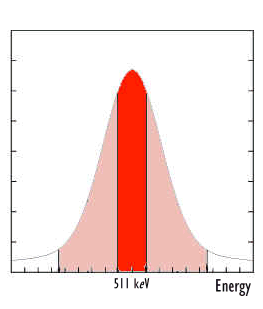
S Parameter is the red area divided
by the pink and red areas
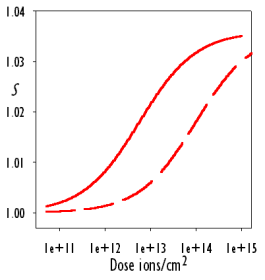
Two plots of the universal curve fitted to
normalized S Parameter for similar ions
at different energies
|
The principle of the technique is that
implanted positrons, rapidly thermalised and undergoing diffusive motion in the material,
are readily trapped by the open-volume (vacancy-type) defects created by the ions. A
trapped positron is much less likely to annihilate a tightly-bound (core) atomic electron.
Therefore, positron annihilation in vacancy-type defects contributes less to the Doppler
broadening of the energy spectrum of annihilation gamma rays than that in the undefected
bulk material.
The Doppler-broadened annihilation linewidth is described by the single parameter S,
which is dependent on defect concentration and therefore on ion dose. S values
are normalised to the value for Si with a negligible defect concentration. This forms the
basis of PAS which, extended to near-surface and thin film capability by the introduction
of controllable-energy positron beams, has been used to study implantation-induced,
open-volume defects since the late 1980’s. |
The absolute sensitivity of S to ion
dose depends on the nature of the ion; however, a universal curve is achieved if the data
are normalised using the peak vacancy/ion/Å values close to those calculated using the
standard simulation package TRIM. This normalisation procedure allows one to estimate the
minimum detectable dose for any ion species/implantation energy; for example, for As, O
and Ge this is in the range 108-109 cm-2. The sensitivity
of the technique has been investigated by measuring normalised S(E) values
for 125 keV self-implanted Si in the dose range 1x10¹¹-1x1012 cm-2.
The sensitivity to changes in dose approaches a few %, and could be expected to be
maintained as the implanted ion energy is decreased (in contrast to non-destructive
optical techniques).
The ability to probe depth-dependent defect distributions also offers the
opportunity to measure non-uniformities in the ion range - eg implantation of large-area
wafers may result in varying amounts of channelling across the wafer because of stresses
induced in the mounting procedure. Additionally, localised hot spots may occur during
high-current implantations if regions of a wafer are thermally isolated; these hot spots
result in reduced damage accumulation during the ion implantation process, increasing
channelling of the implanted ions; both phenomena may be probed by the
instrument.
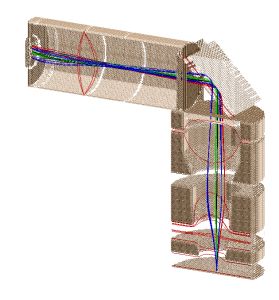
The compact, rugged, computer-controlled positron beam system to be used for
positron dosimetry incorporates features of research apparatus developed over the past 15
years to create a user-friendly instrument. Important design criteria are:
safe radioactive source handling
safe operation of high voltage supplies and vacuum system
robust design
efficient production of slow positrons ®
high data collection rate (short run times)
compact optics with source/detector shielding capability
rapid sample changing facility
computer control of system functions, data collection and analysis
|