Any errors let me know
Generate interface restart file
In this example will consider SrTiO3 (100) surface
The approach is first to generate the surface which is going to host the point defect using the usual stackgen approach. Ensure that the region 1, and region 2 especially, are large, as this will help with convergence, i.e. note "region" size. Try to have region 1 size large enough that the displacements at the bottom of region 1 are as close to zero as possible. Do this by checking columns 7 to 9 at the bottom of the final rel_o####.rel file. Region 2 should be large, at a minimum of 60 Ang (twice Region 2a radius in point defect calculation) + thickness of region 1.
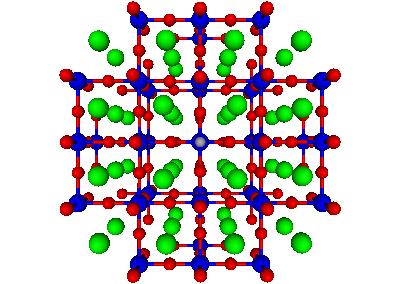
On running this, modify the fino0001.res file
1. remove lines from bulk --> up to surf and remove anal --> start
1. replace minimise by chaos
3. add lines after chaos (before start):
cent 0.0231091953871 1.9540886763309 1.9540886763309 # centre of region 1
defect # start of defects
O CORE vaca 0.0231091953871 1.9540886763309 1.9540886763309 # coord. copied from reg1 block1 and vaca inserted for vacancy
O SHEL vaca 0.0402759728693 1.9540886763305 1.9540886763305 # same for shell, alternative to vaca is inte (interstitial)
ends # end of defects
rad1 9.0 # estimate of region 1 radius
rad2 30. # estimate of region 2 radius > rad1 + short range cutoff
The completed file should look something like:
At present it is essential that in the fin###res file has integers on the right hand side that relate the coordinates to the perfect crystal lattice sites.
Minimise Point Defect
Once this file is submitted it should minimise the point defect, click on picture to obtain resulting code file.
The danger is that the choice of region sizes and centre combine to give highly charged regions. This happens more frequently the larger the region sizes. However, this is easily spotted as the energy goes crazy even with neutral clusters. In general, the defects are likely to be of the order of 10x¦q¦, where q is the charge of the defect, x=+1.2 for a vacancy and -0.8 for a interstial - but this is very rough, but might help spotting the problem cases.
The defect energy is presented towards the end
final defect energy
12 iterations for completion
defect energy = 22.97385 ev
Note: the defect energy may be shifted because of the electrostatic field generated by the interface. To check run a similar calculation but at a deeper location. For example
Check this against a point defect simulation performed by GULP, HADES or CASCADE and then shift all simulations by the difference to correct against the bulk defect calculation.
cent 199.3170571080216 1.9540886763949 1.9540886763949
defect
O CORE vaca 199.3170571080216 1.9540886763949 1.9540886763949 2
O SHEL vaca 199.3170571080216 1.9540886763949 1.9540886763949 3
ends
The calculated defect energy was 23.66352 eV. Thus the segregation energy = 22.97-23.66 = -0.69 eV.

SC Parker